Showing posts with label Health Tips. Show all posts

Friday, November 26, 2010

10 Ways to Avoid a Heart Attack

by Paul W Wilson

A heart attack is known as a myocardial infarction. This occurs when the heart muscle is damaged or does not receive enough oxygen. Many cardiac related problems occur due to blockages in arteries that carry purified blood away from the heart to different parts of the body. Another cause is the formation of blood clots.

Very often, it is quite difficult to differentiate between a heart attack and heartburn. The common signs of a heart attack are a tightness, pain, or discomfort in the chest. Sweating, nausea, and vomiting that are accompanied by intense pressure in the chest. A radiating and intense pain in the chest that extends from the chest to the left arm. A shortness of breath for more than a few minutes. If you have any of the above you must consult the doctor or go to the emergency rooms.

If you even think you are having a heart attack you must call for a cardiac care ambulance, and put under your tongue a sorbitrate or chew an aspirin. If you are allergic to aspirin don’t take one. At the hospital care will include rapid thrombolysis, cardiac catheterization, and angioplasty. They will also administer intravenously clot busting medications.

The risk factors for a heart attack include: smoking, diabetes, high levels of cholesterol, hypertension, family history of heart diseases, atherosclerosis, lack of exercise, obesity, and fast foods.

Reduce the risks of a heart attack by:

1. Quitting smoking.

2. Eating healthy. Avoid fatty foods, excess salt, and red meats.

3. Controlling high blood pressure and diabetes.

4. Ensuring regular exercise at least 30 minutes a day. Walking is most beneficial.

5. Preventing obesity. Doing all you can to maintain weight.

6. Choosing to live a healthy lifestyle.

7. Practicing meditation.

8. Doing regular relaxation and breathing exercises.

9. Undergoing periodic cardiac evaluations.

10. Including foods that are rich in anti-oxidants in your diet.

A killer disease, according to the American Heart Association approximately 58.8 million people in the US suffer from heart diseases. And, about 950,000 Americans die of heart ailments each year. Heart diseases and death from it can be prevented by maintaining your health. Find a balance in life between work and other activities, abandon the couch for the outdoors, don’t watch sports on television play sports instead and you can hope to live a long and fulfilled life.

Be a well informed and caring citizen, read all about heart diseases and preventive care at: University of Maryland Heart Center for Preventive Cardiology -

http://www.umm.edu/heart/preventive.html;

or the American Heart Association -

http://www.americanheart.org/presenter.jhtml?identifier=1200000;

or the National Center for Chronic Disease Prevention and Health Promotion - http://www.cdc.gov/doc.do/id/0900f3ec802720b8/.

The norm prevention is better than cure could lead a whole nation towards good health and well being.

Paul Wilson is a freelance writer for http://www.1888Discuss.com/health/, the premier REVENUE SHARING discussion forum for Health Forum including topics on health care, Children's Health Issues, addiction, Cancer, fitness equipment, Burns & Injuries and more. He also freelances for the premier Web Portal site http://www.Fafoo.com

How to Deal with Stress and Anxiety

Life can be challenging at times and everyone experiences stress and anxiety at some point in their life. Small doses of stress are expected and even healthy when it triggers motivation and problem solving. However, prolonged stress can lead to a multitude of health problems, including increased blood pressure, heart problems, body aches, sleep disorders, depression, anxiety, and poor mental health. Stress can be triggered by any number of events and there are different levels of intensity. Stress can affect a person mentally, physically, and spiritually. Stress can not be avoided. What is important is that you deal with it and find ways to reduce the stress and anxiety.

Difficulty: Moderately Easy

Instructions

Things You'll Need:

Exercise for Stress Relief
  • STRESS BUSTER - Exercise for STRESS RELIEF
This is probably the best way to reduce stress and alleviate anxiety in your life. There is no question as to the health benefits of exercise. Here are a couple reasons it helps alleviate stress.

Exercise releases negative energy and transfers it into something productive. Chemically, exercise releases endorphins (good feelings)and decreases cortisol (stress hormones) in your body. Lastly, exercise, especially intense, acts as a distraction by keeping your mind off of whatever may be causing the stress and anxiety.

  • TALK TO A SUPPORTIVE FRIEND.
If you feel stressed out, it may help to just talk about it and get another perspective. If you have a friend or family member that has the ability to make you feel better by being supportive, give that person a call. Sometimes, just talking through things out loud can relief some of the stress.
  • SET PRIORITIES AND REALISTIC GOALS.
Handle one thing at a time! Many times stress is caused by having too many things on your metaphorical plate. Remove some of these ideas or tasks by either completing them or discarding them for a later time or altogether. This will help you focus on the priorities. - If it helps, make a list of things to get done in order of priority. - Set realistic goals and activities that are within your reach.
  • Relax!
MEDITATE OR OTHER RELAXATION TECHNIQUES. Meditation is a great way to relieve stress and anxiety. If you have racing thoughts, it may be difficult to get into the right frame of mind to meditate. Try this step if you are calm and motivated to ease your mind of all the worries in your life. Meditation will take practice. But, if you find a way to practice meditation, it could prevent future episodes of stress and anxiety.

If meditation does not work for you, try other relaxation techniques. Get a massage or take a yoga class. Even just taking a few minutes and focus on slowing down your breathing or taking some deep breaths can reduce stress.

Relax!
  • Music Relieves Stress - LISTEN TO MUSIC.
Sometimes, music can ease your mind. Different types of music can be helpful for different type of people. For some, loud metal relieves stress and for others calming music works. The point is to find music that puts you in a better mood and reduces stress.

Put on a MP3 player and go for a jog. If you combine this step with exercise, you will feel the stress start to melt away.

Music Relieves Stress
  • GO FOR A WALK.
If you can not do an intense workout, go for a walk. A walk can be helpful to get the blood flowing. It also gives you time to literally walk away from the source of stress and regroup your thoughts.
  • WRITE IN A JOURNAL.
As a writer, I know this is a very helpful way of reducing stress in my life. Journal writing is a great release no matter what your writing skills are. It allows you to blurt out all your feelings and thoughts and get them off your mind. Keep a private journal that is only for you to read so you can be completely honest and free with your thoughts. Write in a Journal
Read more: How to Deal with Stress and Anxiety

10 Lessons Cancer Taught Me

by Donna Davis

When I was 39 I scheduled a doctor’s appointment to have a lump in my left breast checked. After a mammogram, the doctor said that there appeared to be a problem on my right side. Well, being the expert in all things at that time in my life, I told them there must be a mistake. I came in for the LEFT side. They assured me that everything looked fine on the left side but there were some suspicious looking calcifications on the right. After further tests, I was diagnosed with in situ carcinoma (cancer in the breast ducts). It was very, very early and I went through six weeks of radiation.

During that time, I started reading a lot of books including Dr. Bernie Siegel’s “Love, Medicine and Miracles.” One book that really hit home was Dr. Carl Simonton’s “Getting Well Again.” There were sections in that book where I sobbed because it was like someone had been following me for 15 years and knew everything I had done and said. I learned so much. I changed dramatically and so did my life.

Several years later I was suffering from severe fatigue and terrible bruising. I was diagnosed with hairy cell leukemia. This time, chemotherapy was needed and so I went through that process. I’m proud to say that I’ve now been breast cancer free for 12 years and leukemia free for four years.

I learned many lessons in this journey. I share them with you so hopefully, if any of this fits, you can begin making changes in your life to avoid getting hit with the same two by four that smacked me!

1. There is no someday.

There’s only now. There’s a story called “Precious Present” which talks about a mysterious man telling of an elusive present. The point of the story is that being “present” by enjoying the moments in your life is the best gift of all. It’s good to plan for the future, but remember to LIVE TODAY. Don’t put off playing with the kids, using your best china, doing all those things you want to do “someday.” We truly do not know what tomorrow brings. Be aware of what’s happening, really listen to others and trust your instincts. Your life can be so much richer by learning to be present even for just a few minutes each day.

2. Own and express your true feelings.

For most of my life, I would do things I didn’t want to do. I always worried about saying no to others. When I got the leukemia I knew

that the fatigue wasn’t just from the disease. It was also from 20 years of pent-up resentment for doing things and going places because I felt I “had” to. I’ve learned to express my feelings. Now I say no to things that I don’t want to do. But I also tell people I love them more often. I tell my kids “I’m sorry” when I’ve made mistakes (and I make plenty!) I talk to others about my fears, my depression (which plagued me for years) and my failures as well as my successes. Being honest has lifted a huge weight off my shoulders. Interestingly, in the process of becoming more direct, I’ve become kinder. There’s no resentment when you speak from the heart.

3. I’m not a victim.

I choose how I react to situations. Sometimes people ask “Why me?” Except for a brief moment, I didn’t travel down that road. I knew there were lessons I needed to learn. Yes, some days just plain sucked with nausea and fatigue, but I also knew that many others have symptoms 1000 times worse than mine. When you’re open to the lessons, you can move through your situation so much easier and faster.

4. Take care of myself first.

When traveling on airplanes we always hear that in case of emergencies to put on our oxygen mask first, THEN take care of others. That’s a major life lesson. If we don’t take care of ourselves first, then we have nothing to give others. I had excellent doctors, but I’ve learned that I need to know my body and what it needs. All aspects of our life are our responsibility. Get to know you. If you feel better after eating protein, eat it. If you need 8 hours of sleep a night, find a way to get it. You’ll function much better because that’s what YOU need…not what a book recommends. It’s the same with emotions (see #2). Speak from your heart. And spiritually, find the path that’s right for you. It all comes together to make a wonderful YOU, and then you can be there for others.

5. Ask for help.

Sell the SuperWoman cape on ebay! Asking for help gives others a chance to share their gifts and love. Plus, you’ll weigh less because the “I have to do everything” cape is really heavy.

6. Watch your words and especially your thoughts.

I believe that our “thoughts create.” With my cancer, I KNEW I was going to be cancer-free. But earlier in my life I was very critical, judgmental and negative. Watch your words and thoughts for an hour. Did you say or think thoughts like “I’m always tired,” “We can’t afford that,” “I could never do that”? If you keep thinking or saying those things, guess what shows up in your life? Yep…You are tired, you can’t afford that item and you’ll never do that. I challenge you to eliminate the negatives. Guard your words. They are powerful.

7. There is a reason for all things.

Many times things happen in our lives and we don’t understand. We are a small cog in a much bigger picture. Just trust and stay positive. As you get older, you’ll smile at how you’ve weaved this beautiful tapestry called “My Life.”

8. Get rid of stress.

Stress is toxic and it can lead to serious health problems – physically and emotionally. If you are in a stressful situation, GET OUT of it -- whether it’s an abusive relationship, a terrible job, or living in a place or city you don’t like. Stress eventually wins by wearing you out. So read #9.

9. If you don’t like your life, change it!

This and #8 are easier said than done, but if you want a happier and healthier life, start making some changes. If you are thinking defeating thoughts, work on creating more positive affirmations. If you’ve always wanted to learn how to play the piano, start taking lessons. If you’ve always wanted your own home business, find something that sounds fun and start it! As the saying goes, “Life is like a buffet table. You can have whatever you want, but you’ve got to get up and go get it.” And go back and read #5 and ask for help from people you trust.

10. Laugh often. Don’t take life so seriously.

All of us have challenges. Don’t get upset and angry. Laugh more and know that “This too shall pass.”

11. (Bonus Lesson) Reread these often.

Life has a way of intruding and making us forget what we’ve learned. Print this off and re-read it often.

You deserve happiness, love, peace and joy. Don’t let anyone or anything steal that. Blessings…

Donna Davis lives in Tucson, AZ with her husband Bill, their two sons and two dogs. Donna has owned several successful businesses and loves coaching others. To learn more about Donna, her current business and how she helps others achieve their dreams visit http://www.myfuncandlebiz.com

Tuesday, November 23, 2010

Your Medical Checkups Checklist

See when and how often you should be visiting the doctor's office

Everyone puts off doctor’s visits, but seeing the experts for big-picture status reports regularly is crucial to catching diseases in their earliest, most treatable stages. Here’s what to stay on top of:

General checkup

  • Ideally, every year.

Blood pressure

  • Every year at your annual checkup.

Blood sugar

  • Every 3 years starting at age 45; earlier if you have diabetes risk factors such as a family history, being overweight, high cholesterol or high blood pressure.

Cholesterol test

  • Every 5 years starting at age 20. Start earlier or have it checked more often if you have a family history of heart disease or other risk factors for heart disease (like hypertension or diabetes).

Vaccinations

  • Get a tetanus-diphtheria (Td) booster every 10 years. All adults need a one-time dose of Tdap (a combo of whooping cough, tetanus and diphtheria vaccines). In addition, get an annual flu shot, especially if you’re over 50 or have any chronic conditions.

Breast exam/mammogram

  • Do a monthly self-exam and have a yearly doctor’s clinical breast exam. Once you’re 40, have a mammogram every year, maybe starting at a younger age if you’re at an increased risk for breast cancer.

Pelvic exam/pap smear

  • If you’re under 30, get these annually. If you’re over 30 and have gone for 3 years with normal results, you may be able to get a Pap every 2 to 3 years.

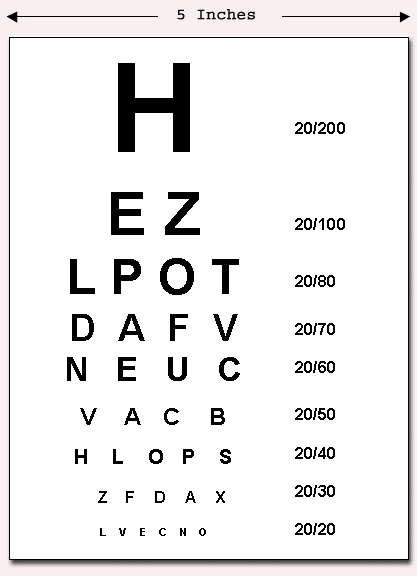
Eye exam

  • Twice in your 30s; every 1 to 2 years starting at age 40.

Teeth cleaning and exam

  • Annually or more often, depending on what your dentist recommends.

Colonoscopy

  • Unless you have a family history of colon cancer or symptoms, you can wait until age 50. Talk to your doctor about how often you should get them.

Bone density test

  • Get screened at least once starting at age 65, but if you have risk factors for osteoporosis (a family history, or you’re taking meds that can affect bone density), your doctor may suggest that you be tested earlier and more often.